
Sword & Spirit Seminary
 Masters of Divinity Degrees
Doctor of Ministries Degrees
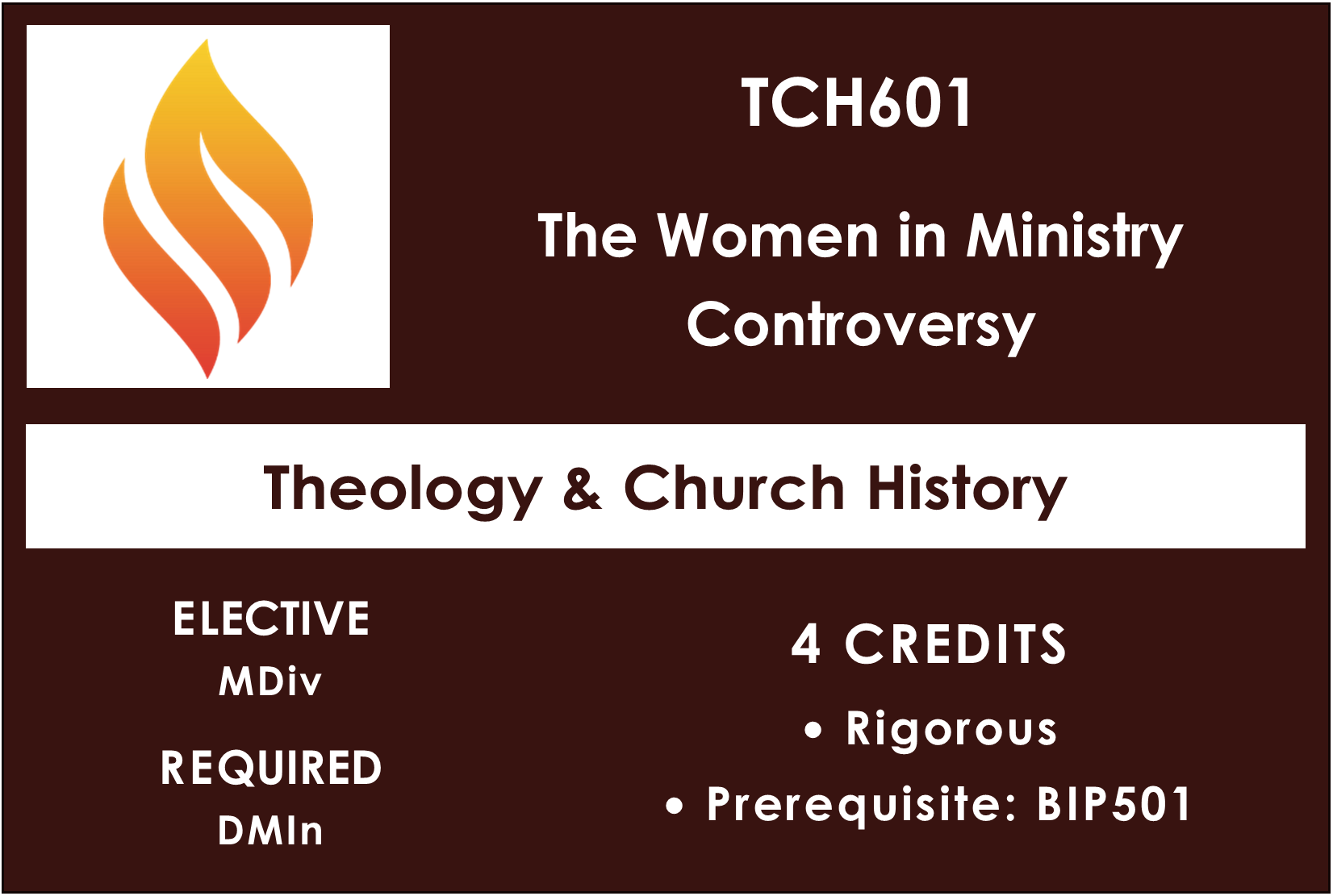
TCH601‒ The Women in Ministry Controversy: Description
 COURSE DESCRIPTION:
Do the well-known New Testament passages regarding the roles of women (1 Cor 11:1-16, 1 Cor 14:34-35, 1 Tim 2:9-15, Eph 5:18-33) teach the subordination of women in church universally and throughout time and culture? Are there other passages that speak to the question?
This course provides students detailed in-depth studies by New Testament scholars with outstanding credentials in biblical interpretation of these and other relevant texts concerning gender. Utilizing sound and imperative exegetical and hermeneutical principles often ignored, this study digs deep into these vital issues.
The course ‒both relevant and important in today’s Christian culture‒ brings needed perspective and insight utilizing 2 books.. one authored by a man, one by a woman. As a bonus, one of the textbooks addresses in detail Marriage in the Letters of Paul, which students may study on their own.
Note the additional resources as listed below.
Requirement Designation: MDiv Elective, DMin Requirement
Prerequisite: BIP501
Credit Hours: 4 Credits
Course Difficulty: Rigorous
Instructional Components: Textbook
Retention & Assessment: Quizzes
Educational Material Authors: Craig S. Keener, Cynthia Long Westfall
GLOSSARY
Among evangelicals, particularly in the last few decades, two rather different
paradigms concerning roles of men and women presented in Scripture have emerged.
Complementarianism
Complementarianism is the theological view that although men and women are created equal in their being and personhood, they are created to complement each other via different roles and responsibilities as manifested in marriage, family life, religious leadership, and elsewhere. Rooted in more literal interpretations of the Creation account and the roles of men and women presented in Scripture, this view is known as the Traditionalist or Hierarchical view. Though the notion is found in other religions, certain Christian groups understand their theology to require a complementarian view of gender.
Egalitarianism
Egalitarianism, within Christianity, is a movement based on the theological view that not only are all people equal before God in their personhood, but there are no gender-based limitations of what functions or roles each can fulfill in the home, the church, and the society. It is sometimes referred to as biblical equality. Egalitarians understand the Bible as teaching the fundamental equality of women and men of all racial and ethnic groups, all economic classes, and all age groups, based on the teachings and example of Jesus Christ. It should not be confused with secular political, economic, social egalitarianism.
Because the Women in Ministry Controversy may be of interest to some of our students,
we have included a course as well as RESOURCES for those not opting to take the course.
In keeping with our policy to help students develop critical thinking skills,
we offer the following resources which thoughtfully address this subject
thought-provoking & well-researched viewpoints.
ADDITIONAL RESOURCES

DEPARTMENT: Bible Knowledge
N.T. Wright
An English New Testament scholar, Pauline theologian and Anglican Bishop, Wright served as Bishop of Durham from 2003 to 2010, and Research Professor of New Testament and Early Christianity at St Mary’s College in the University of St Andrews in Scotland until 2019, when he became a senior research fellow at Oxford University. Author of over 70 books, Wright is highly regarded in academic and theological circles for his “Christian Origins and the Question of God” series.
SSS COURSES
BK502‒ Christian Origins: The New Testament In It’s World


Michelle Lee-Barnewall
Michelle Lee-Barnewall earned her Ph.D. in New Testament studies from the University of Notre Dame. She also holds multiple master’s degrees, including an M.A. from Talbot School of Theology at Biola University.
Her strong background in New Testament studies and spiritual formation brings scholarly depth and pastoral sensitivity to her writing. She has served as Associate Professor of Biblical and Theological Studies at Biola University and continues to speak and write on topics related to Scripture, church leadership and Christian identity.
 Regarding gender relations, the evangelical world is divided between complementarians and egalitarians. While both perspectives have much to contribute, the discussion has reached a stalemate. Michelle Lee-Barnewall critiques both sides of the debate, challenging the standard premises and arguments and offering new insight into a perennially divisive issue in the church. She brings fresh biblical exegesis to bear on our cultural situation, presenting an alternative way to move the discussion forward based on a corporate perspective and on kingdom values.
Neither Complementarian nor Egalitarian: A Kingdom Corrective to the Evangelical Gender Debate

FORWARD BY: